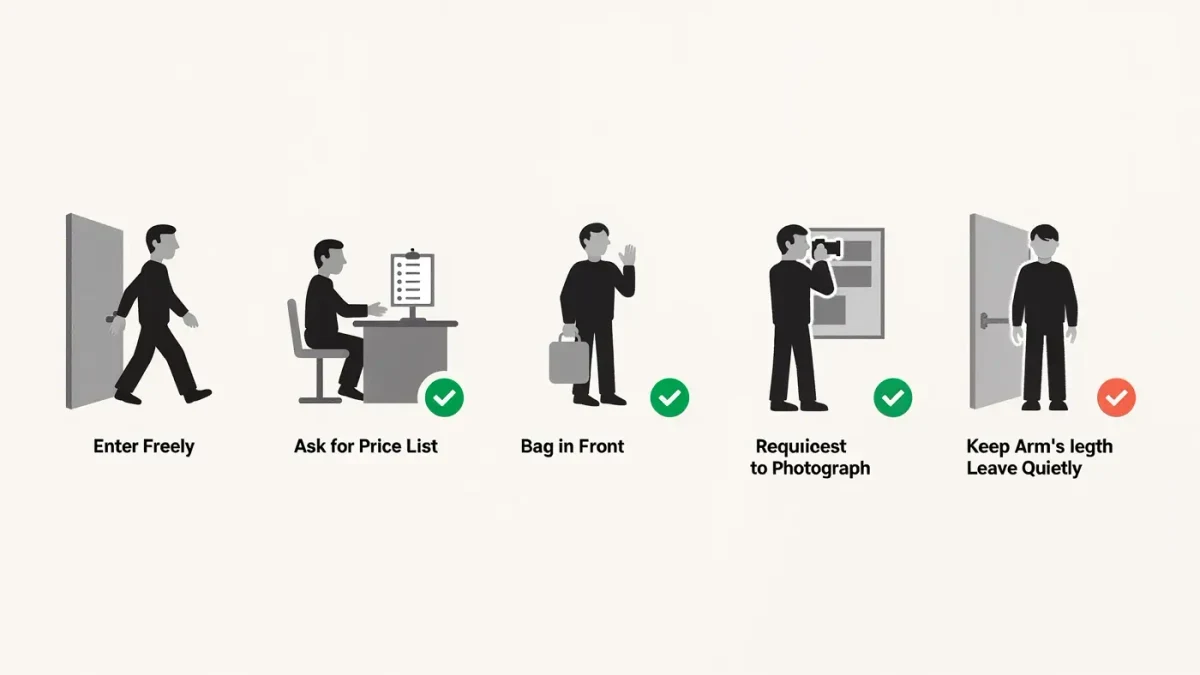
Gallery etiquette in New York comes down to five habits: walk in without paying or booking, keep an arm's length from the art, carry bags in front of the body, ask the desk about prices rather than hunting for labels, and leave whenever the looking is done — with no purchase expected and no explanation owed. Commercial galleries in Chelsea, Tribeca, the Lower East Side and Brooklyn are retail spaces in legal fact, but browsing is their normal condition; the overwhelming majority of visitors buy nothing, and the staff who glance up from the desk are assessing whether help is wanted, not whether the visitor belongs. Most galleries open Tuesday through Saturday from about 10 a.m. to 6 p.m., and entry is free.
The hesitation first-timers feel is structural rather than personal: galleries have no ticket counters, no signage explaining the rules and often no visible staff at first glance, which reads as exclusivity but is simply the format. The rooms are small, the art is unguarded by barriers and the desk sits somewhere near the entrance with one or two people working. Understanding that arrangement — a salesroom that behaves like a small museum — resolves most of the questions below before they arise. What follows reflects standard practice across the city's commercial galleries as of July 2026; individual policies vary, and the person at the desk is the authority in the room.
Is it really free to walk in?
Yes. Entry to New York's commercial galleries costs nothing and requires neither tickets nor reservations during public hours; a gallery door that is unlocked in daytime business hours is an invitation. The exceptions are rare and legible: fair booths during art-fair weeks charge admission, and some project spaces or studio buildings keep irregular hours or appointment-only days, particularly in Brooklyn. If a door is locked, an intercom beside it is the entrance mechanism, not a rejection — press the gallery's button and wait.
What the free entry buys is the room, not a program. There are no wall texts beyond the exhibition's checklist, usually a single sheet near the entrance listing the artist, the works and the prices' availability; visitors accustomed to museums should recalibrate expectations of interpretation accordingly. The sheet itself is a legitimate take-home item, and taking one is standard practice.
Can visitors ask how much a work costs?
Yes, and without apology — prices are the least confidential information in the room. The convention is to ask the desk, in almost exactly these words, whether there is a price list; most galleries keep one, either printed at the desk or in the checklist sheet, and some publish prices on request as a matter of policy. Works are unlabeled with figures because the gallery's sales are negotiated privately and because price placement shapes looking, not because the figure is secret.
Asking commits a visitor to nothing. The desk may ask whether the visitor has an interest in a particular work, which is a service question rather than a sales probe, and the honest answers range from curiosity to collecting intent. First-timers would do well to remember the asymmetry: the gallery's business depends on conversation with strangers, and a polite question is the system working as designed.
What should visitors do with coats, bags and backpacks?
Carry backpacks by hand or in front of the body, keep coats on or checked rather than slung over a shoulder, and give anything dangling a tuck before approaching art. The reason is spatial: gallery rooms are narrow, works hang at turn-around height, and a swinging strap is the most common source of accidental contact in the city's smaller spaces. Some galleries offer a rack or a stool by the door; using it is never required but always welcome.
Luggage is the one genuinely awkward category. Rolling suitcases are unwelcome in most spaces — some enforce size limits similar to museums — and a traveler with bags would do well to build the walk around a hotel check-in or a storage stop. Umbrellas, coffee cups and open water bottles finish the short list of objects that should never travel past the desk; if in doubt, ask, since the request is routine.
Is photography allowed?
Usually, but the ask-first rule governs. A brief question at the desk — whether photographs are permitted — costs nothing and settles rights that genuinely vary: some works are on loan with no-reproduction conditions, some exhibitions forbid flash only, and some galleries decline entirely during installations or for privacy reasons. The default etiquette once permission is given: no flash, no tripod or lighting rig, no staging of companions against the work, and no photographs of other visitors without their assent.
Social-media posting sits in a gray zone that the desk's answer does not always cover; artworks photograph differently than they reproduce, and lenders' conditions sometimes restrict even non-commercial circulation. The safe habit is to include the checklist's credit line when posting — artist, title, year, gallery — which is both courtesy and the sector's citation norm. None of this is policed heavily; all of it is noticed.
How close can visitors stand to the work?
An arm's length, or roughly two feet, is the working standard — close enough to read a surface, far enough that a lean or a stumble cannot reach it. Sculpture on plinths and video works in dark rooms tighten the rule, since plinths are narrower than they read and dark rooms conceal pedestals; benches and walls exist to be touched, art does not, and the no-touching rule holds even for work that looks industrial or sturdy. Children are welcome in nearly every gallery, but the same distance applies, held by the hand if necessary.
The subtler spatial courtesy is crowding. Small rooms mean two strangers looking at one work stand close by necessity, and the norm is to take a turn rather than share a sightline; stepping back for someone shorter, or aside for someone sketching, costs seconds. Looking again — walking back through a room a second or third time — is entirely standard and needs no explanation to anyone.
What if nobody at the desk says hello?
Nothing is wrong. Front-desk staff in commercial galleries are usually working — answering email, preparing documents — and the sector's default is to let visitors look undisturbed rather than greet every arrival as retail floor staff would. A nod or a good afternoon on entering is normal and often returned; a sales conversation is not the expected sequel. Visitors who want to talk should simply say so; visitors who do not will be left alone.
Leaving is governed by the same quiet logic. A short visit — three minutes in a one-room space — is not a slight; galleries track nothing about the duration of visits, and the etiquette on exit is a quiet departure, with a thank-you or a good-bye to the desk if eyes meet and silence if they do not. The front door's bell, where one exists, closes the transaction.
Do visitors ever need to buy anything?
No. The commercial gallery is a salesroom whose browsing public outnumbers its buying public by orders of magnitude, and every function of the room — the free entry, the checklist sheet, the desk's availability — assumes visitors who are looking, not acquiring. The only purchase expectations in the sector attach to fairs and auctions, which are explicitly commercial events with paid entry; a gallery visit ends with the door, not a counter. First-timers who internalize this single point lose most of the format's intimidation at once.
What are the practical details?
Districts: Chelsea (West 19th to 28th Streets), Tribeca (Broadway, Walker and White Streets), the Lower East Side (Bowery to Essex Crossing) and Brooklyn's Bushwick. Hours: most galleries Tuesday to Saturday, around 10 a.m. to 6 p.m.; smaller spaces weekend-only or by appointment; openings on weekend evenings (as of July 2026). Admission: free; no tickets or reservations. Norms: ask at the desk for price lists and photography permission; bags carried in front; an arm's length from the work. Practices vary by gallery and are subject to change.
For more context, read How to visit the Brooklyn Museum.
For more context, read moma first visit.
For more context, read First visit to the Whitney Museum.