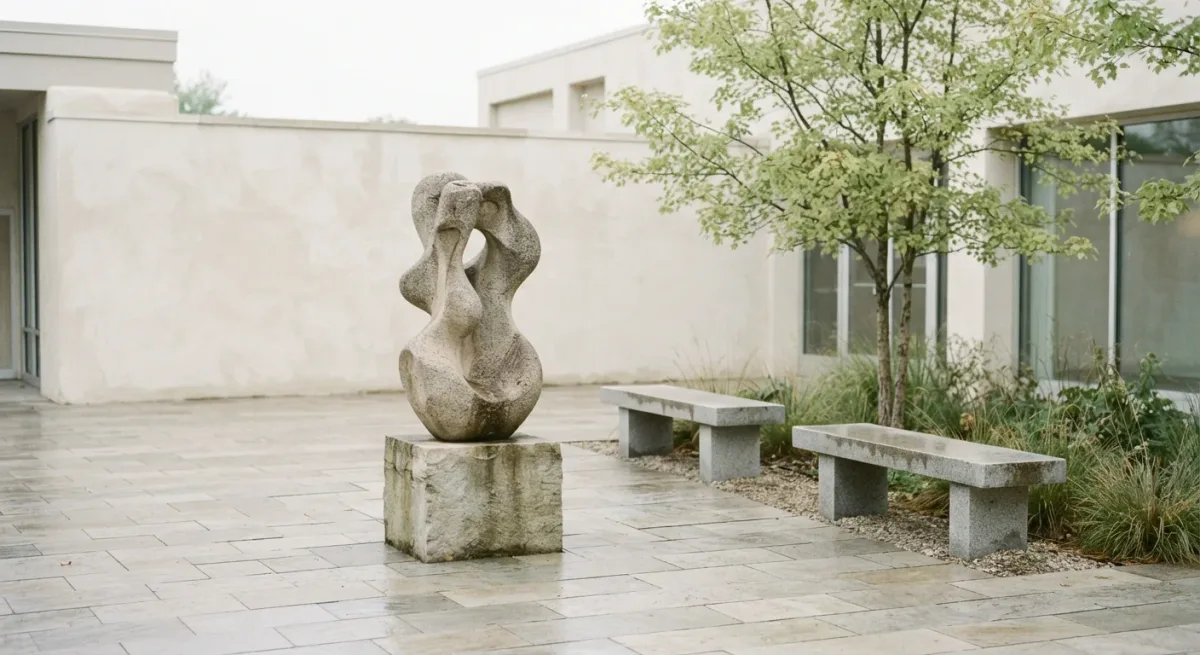
New York's public art is commissioned through three main channels: the city's Percent for Art program, which since a 1982 local law has reserved one percent of eligible municipal construction budgets for art; the Public Design Commission, the city's design-review body established in 1898, which must approve what goes on city property; and MTA Arts & Design, which since 1985 has attached art budgets to transit construction. Together they account for most of the sculpture in parks, the mosaics in stations, and the commissions that appear on plazas — and each follows a process a citizen can trace.
The channels differ in who pays and who decides, which is why a bronze in a Bronx park and a glass mosaic in a Brooklyn station arrive by different routes. What follows is the machinery, in the order a project actually moves.
How does Percent for Art work?
The program, administered within the New York City Department of Cultural Affairs, is triggered when a capital project — a new library branch, a precinct house, a park reconstruction — carries an eligible budget. One percent is set aside, capped, and the program convenes a panel: percent-for-art panels include the commissioning agency, Cultural Affairs staff, art professionals, and community representatives, per the program's published process. The panel reviews artists' portfolios, shortlists candidates, and commissions a proposal, which then faces the design commission's review. The sequence, from capital budget line to installed work, typically runs several years — public art moves at capital-project speed, not gallery speed.
What does the Public Design Commission actually do?
It approves or rejects every work of art, architecture, and landscape proposed for city property — a authority it has held since its 1898 founding as the Art Commission, per the commission's own history. Its monthly public reviews are where proposals for statues, memorials, and park installations are vetted, and its records are public: an artwork that passed or failed is documented in the commission's archive. The commission's approval is why New York's public realm changes slowly, and the public docket is the place to see what is coming before a crane lifts it.
How does subway art get made?
Through MTA Arts & Design, whose founding formula sets aside a portion — up to one percent — of station construction and rehabilitation costs for art, per the program's published guidelines. Station rehabilitations trigger artist selection by panel; the works are fabricated in durable materials — glass, mosaic, steel, porcelain enamel — because they live in the subway. The program's permanent collection now numbers several hundred works across the system, making the MTA one of the largest commissioners of art in the country by volume. The design commission does not review transit authority property, which is why station art can move faster than park art.
Can an artist or a neighborhood propose a work?
Not directly through the capital channels, which are budget-triggered. The practical routes run through the city's temporary-art frameworks — Cultural Affairs' temporary public art program for parks and plazas, and the nonprofit conservancies that program their own sites. A neighborhood's leverage sits in the community-board process and the percent-for-art panel's community seats: when a capital project arrives, those seats are where local preference enters the official record. The stronger version of the other view — that community vetting produces safe art — has its evidence; the program's own record of commissions argues the process produces slow art, which is not the same thing.
Where can the process be watched?
Three public records: the Public Design Commission's monthly review calendar and archive, on the city's website at nyc.gov; the Department of Cultural Affairs' published percent-for-art project lists; and the MTA's Arts & Design pages listing commissioned works by line. A visitor who wants to see the next decade of the city's public realm can read it in those dockets today.
The programs described here follow their published rules as of 2026; capital budgets and program guidelines shift with administrations, and the city's own pages are the source of record.
For more context, read How New York City Actually Hands Out Public Art Commissions.